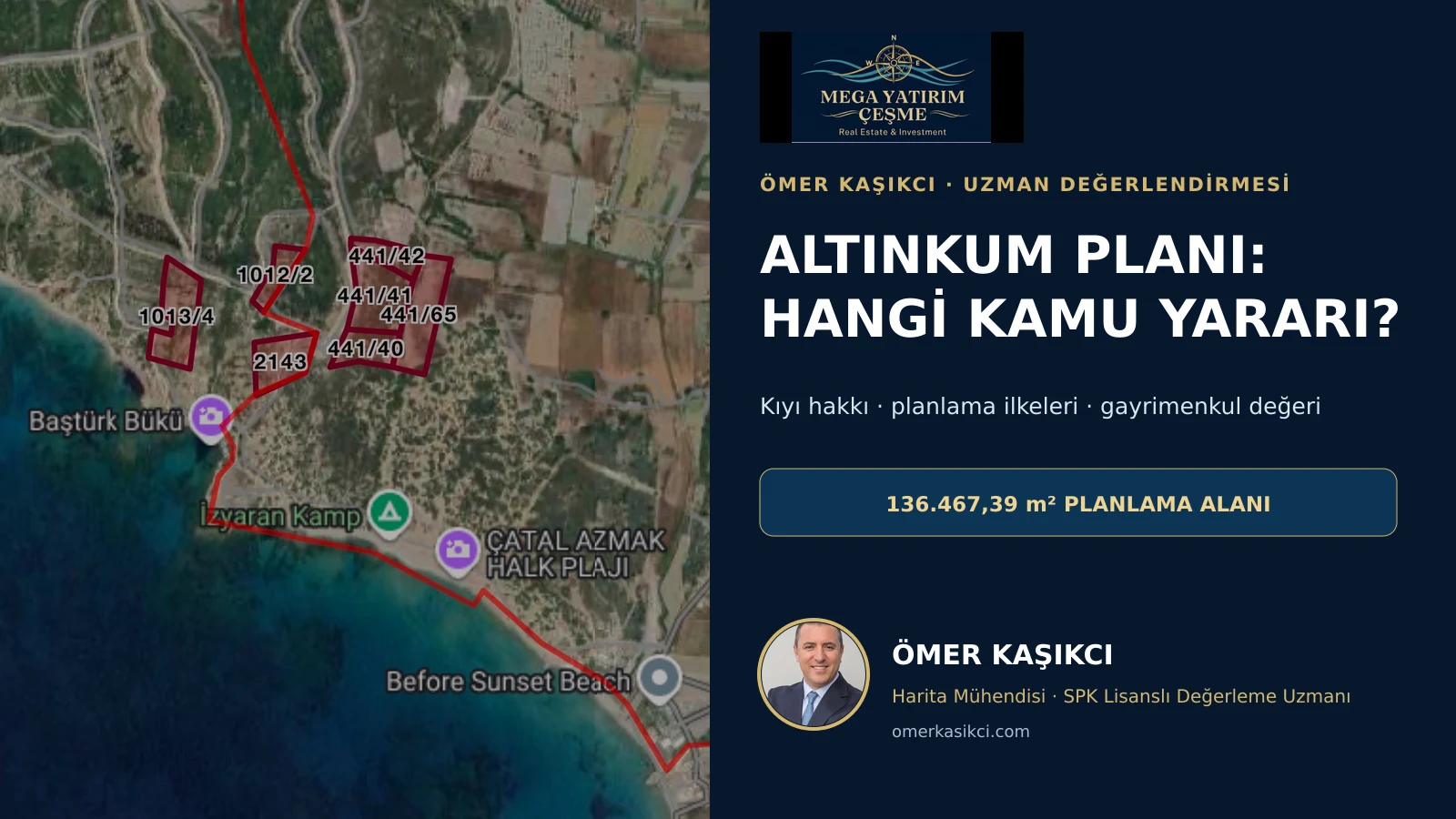
Planning Decision in Altınkum: Public Interest, Coastal Rights and the Future of Çeşme
Ömer Kaşıkcı
Surveying Engineer | Licensed Valuation Expert (SPK)
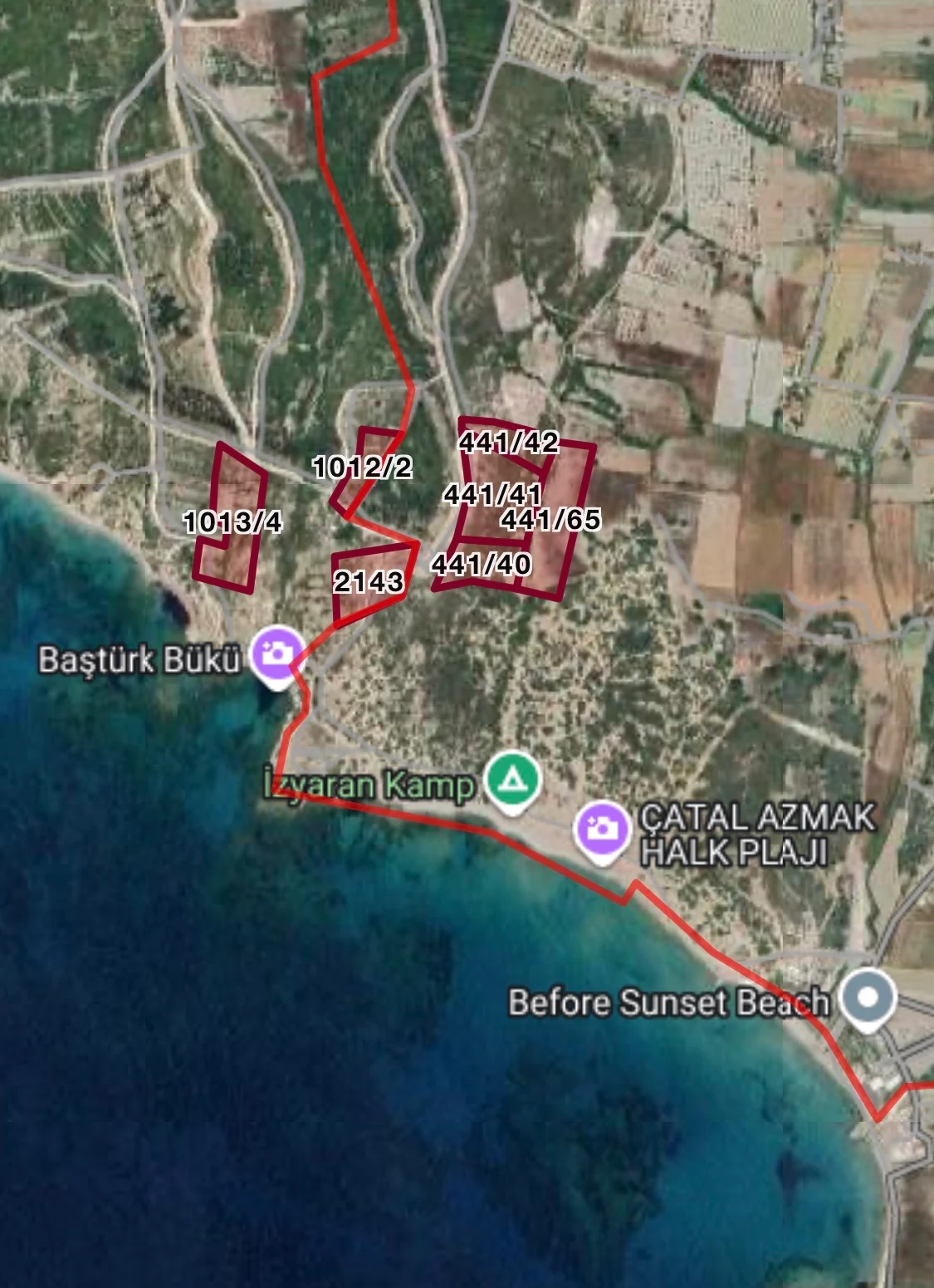
For the area of around 136.467,39 m² covering the Altınkum, Çiftlik and Musalla neighbourhoods of Çeşme, the 1/5,000-scale Conservation-Oriented Master Zoning Plan and the 1/1,000-scale Conservation-Oriented Implementation Zoning Plan were approved on 27 August 2026 and put on public display from 28 August to 11 September 2026.
It is not enough to assess this development only under the heading “new residential, commercial and tourism zoning”. The issue must be assessed by considering together the purpose of the reserve building area decision, the integrity of planning, the public nature of the coast, public interest, institutional opinions, earlier court rulings and Çeşme’s long-term spatial value.
What is in the plan area?
According to the approved plan explanation report, the area consists of four privately owned parcels, three Treasury parcels and unregistered areas.
- Private ownership: 42.114,00 m²
- Treasury: 28.632,89 m²
- Unregistered area: 65.720,50 m²
- Total: 136.467,39 m²
The plan provides for around 75,814 m² of residential development area, around 13,789 m² of commercial–tourism–residential area together with parks, recreation and various social and technical facility areas. A building ratio of E:0.20 applies to the residential areas and E:0.30 to the mixed-use area.
The report also states that the area currently consists largely of vacant, unused parcels. This finding makes it necessary to set out more clearly which concrete regeneration need and which public-interest justification the “reserve building area” decision under Law No. 6306 is based on.
The real issue is not only the floor area ratio
A plan’s compliance with the public interest cannot be measured solely by a low floor area ratio or low-rise buildings.
The real questions are:
- Why exactly was the plan prepared within these boundaries?
- What is the objective justification for planning private, Treasury and unregistered areas together?
- Which disaster risk or regeneration need does the reserve building area decision address?
- What is the effect of residential use on coastal access, tourism infrastructure and the natural environment?
- Has the plan’s effect on transport, water, sewerage and seasonal population pressure across Çeşme been calculated?
- How have the planning and public-interest problems identified in earlier court rulings been resolved?
Planning is not a tool for producing administrative acts that add value to specific properties. Plan decisions must be explainable on the basis of equality, objectivity, plan integrity, urban planning principles and public interest. This duty to justify is all the more important for plans that directly affect a limited number of privately owned parcels.
The coast is not just the line between sea and land
Article 43 of the Constitution places the coasts under the rule and disposal of the State and requires that the public interest be considered first in the use of coasts and coastal strips. The basic approach of coastal law is to keep coasts open to equal and free use by everyone.
According to the plan report, the study area is around 381 metres from the coast. The whole plan area therefore cannot be defined directly as “coast” or “coastal strip”. Nevertheless, coastal rights are not violated only by acts on the coastline itself. The nature of the roads leading to the coast, use decisions behind the coast, areas that create residential exclusivity, parking and infrastructure pressure and actual access conditions can also directly affect public use of the coast.
At this point, the opinion of the Ministry of Culture and Tourism included in the plan report is extremely important. The Ministry stated that the area lies within the Altınkum Tourism Centre, that these areas are planned for public coastal use and the development of tourism infrastructure on the basis of tourism priorities and public accessibility, and that it did not consider residential uses that could obstruct public use to be appropriate.
If a different decision was taken despite such a clearly negative opinion from a public authority, its technical and legal justification must be explained transparently to the public.
The name “conservation-oriented plan” does not by itself ensure conservation
The presence of the words “conservation-oriented” in a plan’s name does not mean that its decisions automatically comply with the principle of conservation. Real conservation is possible through
- respecting natural thresholds,
- strengthening coastal access,
- continuity of public open spaces,
- balancing tourism infrastructure with the public interest,
- protecting water and sewerage capacity,
- calculating the cumulative effect of new construction
.
The İZSU opinion states that a stream bed and two tributaries run through the west of the area, and another stream bed through the east. Given Çeşme’s water, infrastructure and summer population problems, new building decisions need to be assessed not only at parcel scale but at the scale of the peninsula.
The wrong equation in terms of real estate value
Increasing the value of an area is not just about creating new zoning rights. The public nature of the coast, the natural landscape, low building pressure, accessible beaches and regional identity are also basic components of economic value.
In the short term, building rights granted to certain parcels may increase their development potential. However, if the same decision
- weakens public access to the coast,
- fragments the natural landscape and increases building pressure,
- shifts infrastructure costs onto the public,
- erodes Çeşme’s tourism brand and quality of life,
a serious imbalance arises between the private value created and the public value lost.
From a valuation perspective, the right question is not only “how much will these parcels gain in value?”. The real question is:
Does this plan increase Çeşme’s total spatial, environmental and economic value, or does it transfer public value to a limited number of properties?
Why does the earlier court process matter?
The plan explanation report states that the 1/5,000 and 1/1,000-scale plans previously approved in the same area were annulled by a ruling of the İzmir 2nd Administrative Court dated 10 October 2017. The report also mentions another court process concerning part of the upper-scale plan decisions.
It cannot be said that the new plan is identical to the previous one. However, when a new plan is prepared for the same area, it is essential to show clearly how the earlier grounds for annulment have been addressed. An approach that only formally overcomes a court ruling while potentially continuing the underlying planning problems may create new disputes in terms of the public interest.
My professional assessment
Considering the available documents together, I believe this plan should be seriously reassessed in terms of
- making the purpose of the reserve building area concrete,
- the objective justification for the chosen plan boundary,
- its effect on public use of the coast,
- how the negative opinion of the Ministry of Culture and Tourism was addressed,
- whether the requirements of earlier court rulings were met,
- infrastructure, flood and natural-environment impacts
.
At this stage, a definitive ruling of “unlawfulness” can only be given by the competent court. Nevertheless, the available data show that the plan is open to strong legal and technical objections in terms of public law, public interest, the common use of coasts and the principle of objectivity in planning.
Planning that benefits Çeşme does not come from seeing the coast and natural areas as a building reserve, but from strengthening public access, protecting tourism infrastructure, respecting water and infrastructure capacity and transparently justifying planning decisions.
The future of Çeşme should be planned not on the basis of gains for individual parcels, but on the basis of the total public value of the peninsula.
Ömer Kaşıkcı
Surveying Engineer | Licensed Valuation Expert (SPK)
Sound Investment Built on Technical Knowledge
Sources
- İzmir Provincial Directorate – official public display notice No. 2026/64
- Approved 1/1,000-scale plan explanation report
- Constitution of the Republic of Türkiye – Article 43
- Example ruling of the Constitutional Court on the public nature of coasts
This article is a professional assessment based on publicly available plans and reports; it is not a legal opinion or a valuation report for any specific property.
You can get in touch for a technical review of zoning plans, parcels and real estate valuation.
omerkasikci.com